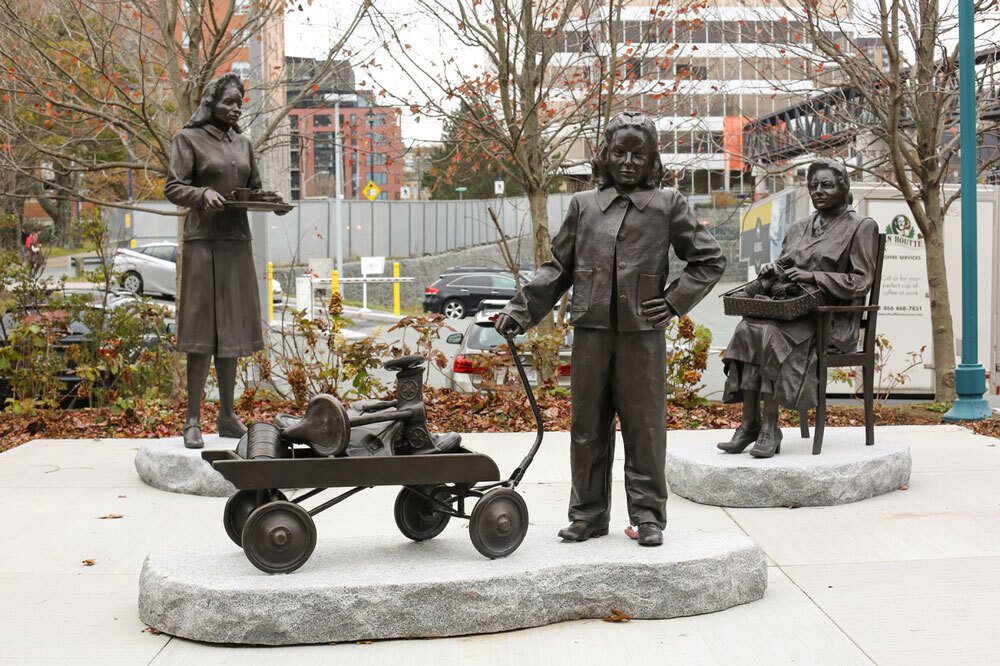
The Volunteers features three bronze figures in honor of the work of thousands of women who volunteered during the Second World War. The public is invited to share stories of women’s volunteer efforts and service during wartime. Join community members to knit comfort items, like in the Second World War when women came together to craft socks, caps, and sweaters through the Canadian Red Cross. Participants are encouraged to share their skills and leave any works-in-progress in the Mi’kmaq basket held by the Women with Knitting figure. NSWHS will be collecting non-perishable food items to donate to Feed Nova Scotia.
The Volunteers is a series of three bronze figures in honor of the work of thousands of women who volunteered during the Second World War. The society invites women and their families who were involved in the unveiling in 2013 to return to the monument and share their stories with the public. Society members will also guide visitors through the story of each statue. The public is invited to connect and share their stories of women’s volunteer efforts and service during wartime. Join community members to knit comfort items, like in the Second World War when women came together to craft socks, caps, and sweaters through the Canadian Red Cross. Samples from the Canadian Red Cross Society knitting instructional booklets will be available for reference. Participants will also be encouraged to share their skills by knitting patterns they are familiar with and leaving notes for the next participant to continue the work, symbolizing the collaborate nature of volunteer and care work. Works-in-progress will be left in the Mi’kmaq basket held by the Women with Knitting figure for the next visitor to complete the next stitch. NSWHS will be collecting non-perishable food items to donate to Feed Nova Scotia. The monument is comprised of three figures, representing three generations: A young girl pulling a wagon full of salvaged metal, an African-Nova Scotian woman holding a tray of coffee and sandwiches, and an older woman seated with a Mi’kmaq basket and knitting. 1. Woman with Knitting Hundreds of thousands of women supported the troops by knitting massive quantities of socks, caps, sweaters and other badly-needed comfort items. The Canadian Red Cross estimates that 750,000 volunteers knit 50 million articles during the Second World War. 2. African Nova Scotian Woman Women fed more than 100,000 servicemen who passed through Halifax on their way to the war in Europe. Meals were one of the most important services women provided. The woman figure is helping serve meals to Black servicemen. Canteens and clubs were segregated. 3. Young Girl with Wagon Children were part of the volunteer war effort. The young girl is part of a salvage drive and is hauling her wagon full of pots, pans and broken toys. The Federal Government encouraged Canadians to salvage materials for conversion into airplanes, tanks and other weapons. The monument was unveiled on the Halifax waterfront November 16, 2017, to honour the work of the thousands of women, who volunteered their time and labour during wartime. It is the first monument with full-sized bronze figures of women in Halifax’s history. It honors the work of thousands of women who volunteered during the Second World War. The Halifax Port Authority provided the land for The Volunteers/Les Bénévoles. The Society raised about $600,000 dollars from many generous sponsors. They all made the monument a reality. The design, by well-known Canadian artist Marlene Hilton Moore was chosen in a national competition.