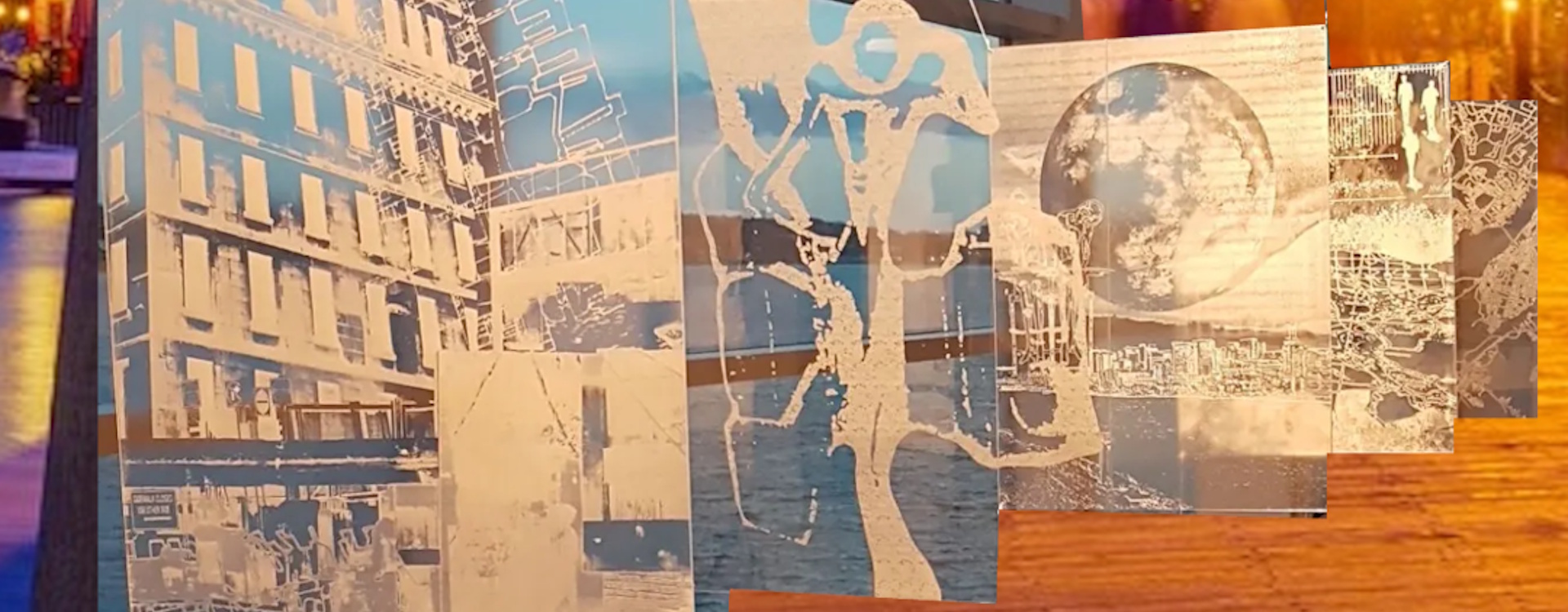
Visible Cities is an installation that explores a series of distinct experiences of the city, visually placing them in conversation with one another. In this work I am considering the city both as a physical structure, and an invisible framework, shaped by idiosyncratic social, cultural, and spatial relationships. By pulling apart some of the unseen layers just enough to allow viewers to encounter them, the work aims to reveal the sheer multitude of layered spaces we move through daily, and expose the city as a site of overlapping spatial realities.
Drawing on Michel de Certeau’s distinction between “place” and “space", the installation, Visible Cities, investigates how multiple “spaces” can overlap within a single “place”. The distinction between “space” and “place” invites us to see place as something fixed, solid, mapped, and named, while space emerges through movement, interaction, and lived experience: through walking, observing, remembering, and inhabiting. In this sense, space is practiced place. A place, defined by an instantaneous configuration of positions (which precludes the possibility of two things being in the same location) is activated by the bodies that move through it and the stories that unfold within it.
Recognizing the multiplicity of layered spaces exposes the city as a site busy with overlapping realities. What appears as a single street may simultaneously function as a workplace, a site of protest, a childhood memory, a border, or a refuge, depending on who is moving through it. Each perspective generates a different spatial experience.
The installation consists of five upright, laser-engraved acrylic panels arranged in a row. They are installed with enough room so that viewers can engage with/observe each individual panel, or stand back from various vantage points to visually layer the panels together. This shifting perspective visualizes the layered nature of multiple realities coexisting in the same physical location.
Inspired by Italo Calvino’s book “Invisible Cities”, the work aims to pull apart the unseen layers just enough to allow viewers to encounter each individually, but not so far as to disconnect them from one another, they are distinct yet remain connected. Rather than presenting a seamless visual narrative, the work emphasizes simultaneity while also presenting a collision of overlapping imagery. By foregrounding the tension in simultaneity, the work challenges viewers to question dominant or authoritative representations of urban space and instead consider the quieter, often unseen practices that produce meaning. I am asking: Whose experience defines a place? Who has the power to transform space into place, or to erase it? How do everyday gestures like walking, lingering, or avoiding, subtly reshape the urban fabric?
Ultimately, this framework shifts the city from being a neutral stationary body into a dynamic process to be lived. It implies that individual interactions with public places, through even subconscious creation of spaces, can dramatically alter the function of our built environments. I hope the work encourages viewers to think about their own spatial practices, and those of others around them, and to feel empowered by the fact that the city is not merely where we are, but something we continually create.